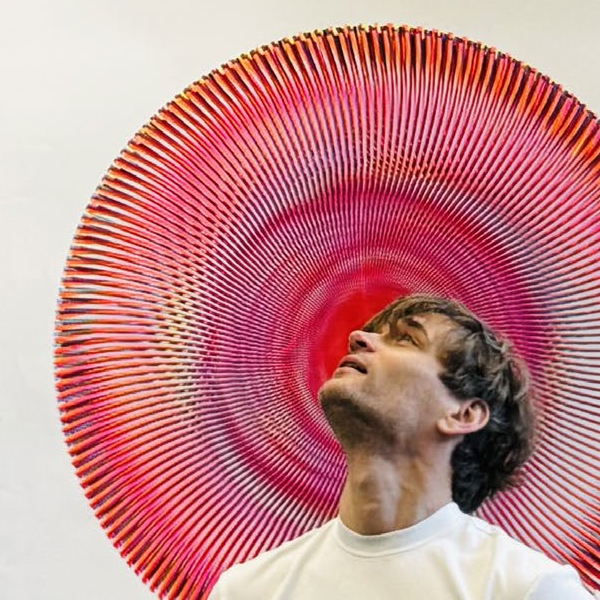
 Piotr Skowron born in 1984 in Łódź, is a graduate of Graphic Arts at the Strzemiński Academy of Fine Arts in Łódź. In 2025, he achieved a habilitation degree in fine arts. He currently works as an assistant professor at his alma mater, in the Screen Printing Studio run by Dr. hab. Agata Stępień.
My artistic work focuses on the relationship between image and space, perception and the time of reception. I work with graphics, although I have long since ceased to treat it solely as a technique – rather as a way of thinking: about repetition, matrix, module and how much they can be explored before the image begins to defend itself. I am interested in the moment when a work stops being ‘for viewing’ and starts being ‘for experiencing’ – preferably when the viewer is not entirely sure whether it is the image that is changing or just their perception of it.
One of the key stages of my work is the series “Interferences”, in which I consistently try to bring static graphics to life without using any special effects other than patience and excessive precision. These works are created from linear rasters, shifts and layers which, when multiplied appropriately, begin to generate visual vibrations, pulsations and a slight cognitive unease. The image looks as if it is reacting to the viewer’s presence, although in reality it does nothing but remain itself. This apparent instability is more important to me than the form itself – because it undermines the belief that a work of art always “behaves” in the same way – the image seems to react to the viewer’s presence.
The phenomenon of interference becomes not only a formal effect, but also a metaphor for the relationship between the work of art and the viewer. It is essential for me to transcend the plane of the image and introduce graphics into the third dimension – through scale, mode of display, and thinking about the image as an object or element of a larger spatial arrangement.
I treat my work as an open process – a series of trials, errors and small shifts that lead to surprising results. A slight change in perspective is enough for the image to start behaving differently, and me – at least for a moment – to feel that I know again why I am doing all this.
THE PULSE OF ABSTRACTION
An encounter with Piotr Skowron’s works is primarily a source of numerous
aesthetic experiences. We try to place these artistic explorations in a broader
cultural context. We recognise some of the author’s inspirations and personal
fascinations. Some seem clear and obvious to us. Others are confirmed by
the artist himself. These are mainly artists from the op-art circle with their
mathematically oriented, rule-based form of abstract art, which creates illusions
of three-dimensional space and confuses the viewer with the relativity of the
objects’ positions. This art uses repetitions of forms and colour combinations to
achieve effects of vibration or circulation of motifs. In this context, Piotr Skowron
points to the paintings of Wojciech Fangor, but also to the colourful planes of
Mark Rothko’s paintings, which represent yet another artistic trend.
Blurred at the edges, radiating fields of colour found in the paintings of the
artists mentioned above are replaced in Skowron’s screen prints by openwork
concentrations of lines, as if they were bands of coloured fibres subjected to
algorithmic shifts and interferences. As a consequence of his creative method,
the compositions become more concentrated in the centre of the image,
irrevocably moving towards the plane surface.
The context in which the artist’s works are set is obviously not limited to the
evocation of specific – in some respects already historical (though still attractive)
– artistic and cultural formations.
It is, in a sense, a mathematically oriented art. In the case of the works in
question, such a reference is not surprising. After all, it is mathematics that
provides inspiration and solutions to the primary questions posed by aesthetics,
especially those concerning the concept of beauty. In many works of various
trends, the relationships between components, rhythms and harmonies are often based on mathematical proportions and divisions, creating spectacular
complex compositions. Getting aesthetic satisfaction often arises from a sense of
conciseness, restrained artistic expression and clarity of message. In this sense,
it is an intellectual aesthetic, although its representations often evoke deep
emotional impressions in us. At the same time, the works are the result of the
artist’s painstaking efforts, characterised by precision and attention to the purity
of the message.
Piotr Skowron does not create anecdotes, he moves in a creative space free of
semantics, he does not construct a sign or any symbolic structure. In the case of
this body of work, we are dealing only with the effects of formal actions.
The artist is also not interested in print runs of identical graphics. Each work has
its own autonomous value. And each subsequent work bears the trace of the
artist’s curiosity, as if it were an attempt to solve a specific, single formal problem.
The titles of the prints are prime numbers which in the case of subsequent works
do not form an orderly sequence, either ascending or descending logically.
Considering the consistency of the creative method adopted, the conscious use
of a limited, similar set of means, it can be said that the works are characterised
by variability, an element that increasingly accompanies the contemporary
approach to the issue of graphic edition and the question of the repeatability or
uniqueness of a print.
In his creative practice, the artist draws on the phenomenon of interference
between overlapping layers of varying density and colour. Minor shifts in the
components of the composition result in a kind of artistic “butterfly effect”,
expressed in the image layer in consequences that are difficult, if not impossible,
to predict. The dependence on the initial conditions is very sensitive here;
a minor disturbance can lead to a completely different final result.
Like all fantasy figures, they function between life and death, the status of human and monster. It is worth recalling, which is also emphasized in feminist reflection, that a similar form of existence characterised witches (also crazy and hysterical women) who existed on the borderline of two worlds, the real and the post-sensory. Their image is a model of a woman who identifies herself as a being in harmony with nature, or who even rules it. Women operating in the realm reserved for witches, hysterics and the insane would thus experience – available to few – a special initiation and elevation.
The effect of surprise appears already at the stage of transferring the image
from the preliminary design, which was created on the screen, onto paper (or
plexiglass or glass). Due to the parameters of the matrices that can be used,
large-scale works are later burdened with traces of their integration into the
whole composition. Numerous smaller-format works are burdened with the risk
of unwanted, excessive density, which is why the artist varies the thickness of
the lines depending on their distance from the centre in order to “lighten” the
image. The visual components, concentrating in the centre and simultaneously
moving towards the edges of the image, cause another type of disturbance (the
“moustache” effect, as the author himself describes it) resulting from technical
limitations, i.e. the fact that the screens do not have a sufficiently large printing
area. For us, the viewers, this is a desirable manifestation of the disturbance of
cool, precise mathematics. Although the artist denies creating meanings, the
viewer, perceiving the graphics and relishing their form, subconsciously feels that
these concentrations and dispersions of matter, subjected to a kind of imaginary
“movement”, are a sign of the structure of a mysterious process and a symptom
of birth of some new, undefined existence.
The disturbances are physical and visual in nature, but also metaphorical when
interpreted in a philosophical dimension. The artist focuses on the aesthetic
message, but it also has ontological value, concerning the nature of existence,
its susceptibility to all kinds of disturbances and the consequences arising from
these interruptions. Looking at the works, we think about the fact that every
phenomenon, every event emerges from nothingness and blossoms to its
fullness, while at the same time every continuum tends towards disappearance
or exhaustion.
In the background of Piotr Skowron’s personal, creative explorations lie
numerous earlier analyses of our reception habits, mechanisms of perceiving
reality, the secrets of physiology of the human eye, and the process of
interpreting illusions.
The determinants of his artistic endeavours are space, light and colour. Using the
technique of consistent, discreet shifting of successive, adjacent elements, the
artist creates visual relationships between the arrangements he has conceived.
These, entering into various relationships with each other, form more compact
structures in selected parts, which consequently constitute a kind of colour
dominant.
Layered arrangements of abstract, rhythmic elements, subjected to various
tensions, create an impression of depth and subtle movement. The components
seem to circulate and radiate. The effect is also enhanced by the type of paints
used by the artist – metallic and fluorescent.
Interesting effects are achieved by displaying the prints in the exhibition space,
detached from the plane of the walls. The author’s installation breathes life into
the graphics. A change in the conditions in which they are displayed and viewed
– simply adjusting the distance from which we look at the works, the difference
in perspective, the lighting – makes the entire space dynamic: it shines, moves
and pulsates. Thanks to the artist’s work, the complex structures reveal their
internal energy and are subject to a kind of radiation.
The effect created by the sequence of abstractions, sometimes several metres
long, is captivating. The feeling – obviously subjective and unintentional on
the part of the artist – takes on an almost metaphysical character, even though
the artist’s actions are very rational. However, this rational, artisanal approach is
accompanied by an emotional undertone that influences the overall expression
of the work, especially in terms of the selected components of the palette. After
all, each of the works stems from the artist’s personal needs and his current
condition as a human being. And that is why not all works are completed;
some are waiting to be developed in the future. Piotr Skowron’s work, although
expressed in separate statements, paradoxically constitutes a single, constantly
developing experiment.
The aesthetic formula developed by Piotr Skowron is – despite its broad and
significant roots – very individual and recognisable. The creative process,
although supported by digital technology, requires mastery of craftsmanship,
precision and patience. Piotr Skowron’s screen prints are characterised by
perfection of execution. They are also distinguished by a subtle decorativeness,
and the works seem very ephemeral at the same time. The abstraction in his
graphics ceases to be solely cool, analytical or intellectual; it is capable of stirring
emotions.
It combines what arises from the sphere of artistic and research cognition with
an aesthetic experience, not devoid of broader reflection on the nature of the
phenomena surrounding us.
Dariusz Leśnikowski
Translated by Elżbieta Rodzeń-Leśnikowska
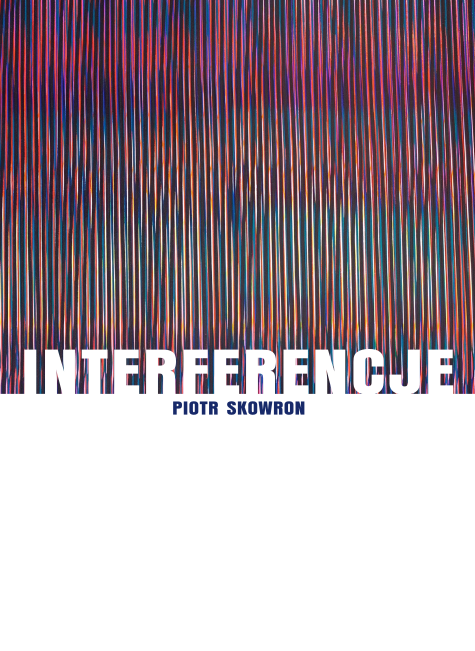 CATALOGUE DOWNLOAD