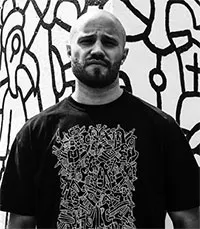
 Maciej Walczak was born in 1992 in Zgierz. From 2011 to 2015 he studied interior design at the University of Technology in Lodz, and then from 2017 to 2022 he studied at the Faculty of Graphics and Painting, the Strzemiński Academy of Fine Arts in Lodz. His artwork is a journey into himself, full of contrasts, personal experiences, emotions and absurdities, which he illustrates mainly with a line. Although he is mostly known for his black and white murals created in the horror vacui style, he also deals with abstraction (serigraphs). His works are characterized by meticulous craftsmanship and precise drawing. The artist assumes that the human personality is a complex creation and even in art it cannot be expressed in a universal way, hence his experiments with various media. For him, art is a means of communication with the world and an area for expressing content lost in the depths of the unconscious. The black and white colour scheme reflects his austere way of life and binary view of reality. Although at first sight his works seem to be controlled by chaos, it is chaos disciplined and tamed with the whip of perfectionism.
instagram: walcz_ak
www.facebook.com/maciejwalczakldz
ON THE DARK SIDE, ON THE BRIGHT SIDE
Maciej Walczak addresses a wide range of street art activities in his work. Although this art finds its way into galleries and museums, it still functions as a kind of tattoo carved on the body of the street. It is an important aspect of modernity, drawing attention to itself with its different nature of communication, both in terms of the audience reach and the form taken.
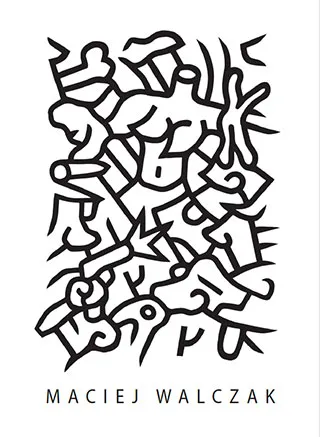
Maciej Walczak, like the early medieval barbarians, fills the entire surface of the plane with ducts of lines. That is why he is eager to go out into the street. The scale of the place allows him to freely appropriate the surface there. It seems as if what he does is just a fragment of a message that unfolds, in space and time - infinitely. The painter's hand delineates the contours of dynamic figures that enter into various relationships with one another. The compositions are open, the lines go somewhere in different directions, change course, the outlines of the forms break off at the edges, escape beyond the boundaries of the painting. Thus, the story spun by Walczak never ends. This is because the author's works are not born in isolation from the world in which he functions this small (and not insignificant) personal territory of the artist, as well as the social and historical space with all its circumstances.
Walczak's street actions take on the character of personal rituals, performed by a contemporary urban shaman. Horror vacui in his realizations is some form of compensating for deficiency, overcoming subconscious premonitions and fears, urges and anger. In this sense, artistic activity is a kind of therapeutic self-expression. Maciej Walczak's visual representations grow out of a particular culture and are an anarchizing opposition to the official forms of communication operating in the street space or the interiors of public buildings. They function alongside flashy billboards and light boxes, other forms of advertising and information. The author responds to their garishness with his own visual noise. The complexity of Walczak's messages is noticeably large, as large as the abundance of everyday messages that reach us from all sides. Reacting to the external chaos, the artist tries to drown it out with an element released from its tether, which with its dynamism and vitality corresponds to the multiple sounds of the street. He reacts to the strangeness and chaos of the surrounding space, and at the same time tries to establish a bond with it. This is one of the fundamental contradictions evident in Maciej Walczak's artwork.
However, in the very nature of the works created, one can see a certain - perhaps incompatible with the chosen convention - care, refinement of drawing, consciously maintained continuity of narration. It is thanks to this that we do not go by these compositions indifferently. Having recognized a particular situation, we stop to follow the line that leads us - to find the subsequent components of the story, as in myths written in the artist's special personal language. Contrary to expectations, Walczak does not use a paintbrush in a chaotic manner - the forms he builds are well thought out, drawn carefully and they enter into various relationships with each other. The complex form of his graffiti no longer requires the use of other spectacular and garish means of expression. The street compositions are in a sense modest - the artist has deliberately limited the colour means of expression to black and white, for example. Maciej Walczak does not hide his fascination with selected cultural forms. He is inspired by myths, beliefs, rituals. Ultimately, however, the works created must correspond to an inner need and be an adequate reflection of it. When the author is not satisfied with the result, when the effect does not meet his expectations, he destroys it, even if its creation was preceded by hours of work. The sources of inspiration in Walczak's work are discernible not only when he develops multi-meter wall compositions. The vigorous nature of the street man is also evident in his graphics and drawings.
There, from the beginning, one could also see that tendency, characteristic of the author, to use numerous possible concentrations in the visual layer; in doing so, the artist departed from representational forms. The bold handling of not always manageable stain of colour as a means of expression is a testimony to a liberated expression, originating in the subconscious, which is resistant to unambiguous interpretations. Among other things, it has its source in the mood accompanying creation, reinforced by the character of the music listened to, which often remains in correspondence with the visual work.
Maciej Walczak's drawings are enriched with new means of expression. The contour of figural motifs is deepened by the shadows cast by the forms, their perceptible spatiality and depth are formed.
In graffiti, violent expression was sometimes curbed and it remained at the level of the mental layer. In graphic art, inner emotions can be accompanied by the use of more brutal tools, passion has a more physical dimension. A certain roughness and greater expressive power of the finished works appear.
Maciek Walczak's compositions are a map of a journey through the world full of contradictions. A journey made, admittedly, with problems, but certainly not affected by boredom.
Dariusz Leśnikowski
Translated by Elżbieta Rodzeń-Leśnikowska
 CATALOGUE DOWNLOAD