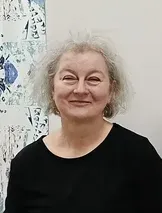
 Dorota Sak
studied at the State Higher School of Fine Arts (now the Strzemiński Academy of Fine Arts) in
Lodz. She graduated with honours in 1990. She works at her alma mater. From 1998 to 2009, she ran the
Clothing Construction and Modelling Studio, and from 2009 to 2021, the Clothing Form Design Studio. Since
2021, at the Institute of Fashion Design, she has been teaching her original course, Composition in Fashion
Design. From 1999 to 2002, she was a member of the Council for Higher Art Education at the Ministry of
Culture and National Heritage. From 2012 to 2016, she served as head of the Department of Fashion Design
at the Academy of Fine Arts in Lodz. In 2014, she founded the LOOK Gallery at the Fashion Promotion
Centre in Lodz, which she ran until 2019. In 2019 she was awarded the title of Professor of Art. She is the
initiator and participant of international conferences and artistic projects, as well as an exhibition curator.
As part of the European Erasmus+ programme, she taught at the Academy of Fine Arts in Vilnius and Telšiai
in Lithuania, and at the St. Cyril and St. Methodius University in Veliko Tarnovo, Bulgaria. In her work, she
addresses existential and environmental issues, as well as cultural heritage. She creates works in the field of
fibre art, painting, fashion design and digital graphics. Her works have been presented at numerous solo and
group exhibitions both in Poland and abroad.
COMMON HERITAGE
When in 2020, during the great pandemic, Dorota Sak summed up thirty years
of her creative work with a grand, magnificent exhibition at the City Art Gallery
in Lodz, her artistic visions took on a special dimension. The artist experienced
more deeply than ever – and sought to express this in her art – the fragility of
our existence, the unpredictability and sudden volatility of fate. Our system of
beliefs was suddenly put to a severe test, subjected to a painful re-evaluation.
Fitting within the framework of posthumanist reflection, Stardust is a kind of
post-pandemic, bitter reflection on the human condition and our place in the
universe. In moments of sudden confrontation, we stand helpless in the face of
cataclysms that shatter our certainty and destroy our sense of well-being. All it
takes is a new virus or a mutation of a well-known disease for the world to be
turned upside down.
Dorota Sak focused on a new artistic approach. The inspiration for her new,
spectacular compositions came from an object that was seemingly trivial but
significant for that time: a pair of disposable gloves. The way in which the artist
approached the presentation of this motif in her new works had a huge impact
not only on the emotional charge of the pieces created consequently, but also
on their formal dimension. Then came the motif of hands, another expression of
helplessness and a cry for help. The sight of 150 hands reaching out into space
became a dramatic expression of the artist’s feelings, aware of the uncertainty
of our existence and the futility of many of our quests. The original project,
expanded and filtered through computer programmes, took on a monumental
character.
During the pandemic, when people had fewer opportunities for direct contact
with nature and focused more on communication via digital tools, they were
forced to reflect on the nature of our relationship with the world around us and,
as a result, on the nature of our perception of reality in the digital age, to what
extent new media shape our perception, and to what extent they distort and
falsify reality.
Today, our actions with digital tools not only perpetuate the image of the world,
but often they transform it; we create an image tailored to our expectations
and imagination, deliberately departing from its natural form. It is no longer
enough for us to capture it in photography. Fascinated by the rich possibilities
of transforming the image, we enhance it and, by analogy, take delight in our
omnipotence as masters of nature. On the one hand, the tools at our disposal
help us understand and get closer to nature; yet, to the same extent, they can
distance us from it and disrupt our secure relationship with it.
Dorota Sak’s recent works are vibrant pieces, rich in visual detail. We can
recognise in them the aesthetic paradigm characteristic of the artist’s entire
oeuvre, based on modularity and the repetition of motifs. Her earlier painted works were created using stencils and paint rollers. Today, the artist employs
other, modern tools for shaping the pictorial layer in her work.
The complex compositions refer to the mechanisms of our perception of reality
and the nature of visual processes – issues once addressed in a pioneering
manner by Władysław Strzemiński.
Both "Gardens" and "Seasons of the Year" are series of works inspired by intimate,
close encounters with nature. The artist photographs the details that captivate
her, using macro photography, to take a close look at what we usually overlook
in our daily lives. The choice of objects is not random; the artist captures these
– often mundane – motifs that offer an intriguing form, an interesting structure
and the contrasts contained within it.
Thanks to complex digital processing, the details move away from their physical
concrete form, though the attentive eye of the observer is able to find the
original sources of inspiration in the resulting composition. The artist’s sensitivity
does not allow her to completely abandon nature in favour of the digital world.
In the course of subsequent interventions, the patterns are multiplied, inverted,
juxtaposed, subjected to rhythmic variation and the organising power of
symmetry. The multi-layered strata of forms and colours evoke the impression
of mobility of the constituent elements, vibrations of the surface. Various
dissonances emerge on the surface: of size, shape and colour.
Dorota Sak has never shied away from bold colour combinations. The artist,
utilising the capabilities of digital tools, handles colour very boldly, yet carefully
controls the selection of hues and their tones. This is particularly evident in the
construction of colour palette that corresponds to the character of the four
seasons, at times radiating with the energy of a hot summer, and at others with
the coolness of winter colours.
The works serve as a visual reflection of the mystery of life and death, both
in relation to the cyclical changes in nature and to human existence – the
cradle-to grave process. Symbolically, they reach their culmination in a work
suspended “between heaven and earth”, the sacred and the profane, entitled
Tree of Life. This is an important installation in Dorota Sak’s oeuvre, expressing in
a visual form the idea of endurance, vitality and life.
Behind these multifaceted compositions lie numerous symbolic aspects and
references to various cultural motifs, including biblical and religious ones: the
topos of Eden − the Garden of Paradise, the myth of the Golden Age, and the
aforementioned archetype of the tree of life. We also note the presence of
inspirations drawn from diverse cultures − particularly those of the East and
South − and their characteristic artistic formulas, which have long been present
in Dorota Sak’s work.
These works reflect the immense, astonishingly rich complexity of the
world’s components, both those represented by nature and those created by
humankind – as well as their mutual relationships.
Throughout her work, the artist has repeatedly explored how different cultures
construct and define their identities. She has sought to highlight the extent to
which these phenomena influence and intertwine with one another, in turn
giving rise to new qualities: social, cultural and aesthetic ones. To what extent
can their components serve as the seed for understanding, exchange and
synthesis?
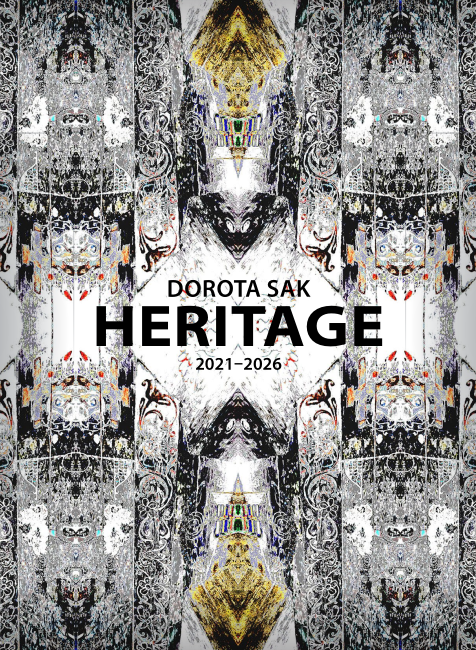
This significant aspect has been developed in the next series, entitled Heritage.
In it, the artist addresses the issue of shared memory and creatively explores
our cultural heritage. Its elements have always been a source of inspiration and
imitation; they have been the subject of fascination, absorbed and transformed
by successive communities. Sometimes we do not realise that even those
elements furthest from us in time and space are still present within the tissue of
our native culture
The digital reworking of iconic cultural motifs − paintings, sculptures, mosaics,
written texts − does not obliterate them within the image. They are there,
fragmented, multiplied, reduced almost to abstraction. In the dense interplay of
forms and colours, the arms of crosses rise upwards, angels stand in rows, and
fragments of text break through.
The visual compositions are created from material consisting of traces of the
past, but are constructed using contemporary digital tools. The final effect
corresponds to the nature of today’s pixelated, constantly evolving visual culture.
In the subsequent stages of work on the piece, as in the series devoted to nature,
the distinctiveness of the original elements gradually disappears. After digital
processing, they reach the form of artistically sophisticated signs in the visual layer.
The image takes on the character of a colourful mosaic within which quotations
from the past coexist, as in a palimpsest. Their traces are inscribed into the
structure of today’s cultural artefacts. They create an intermedia dialogue
between ancient heritage and the visual culture of the present day. Against the
backdrop of their common image, the manual perfection of the ancient artist
and the simplicity of the tools at his disposal are set against the possibilities
offered today by digital technology.
Once again, the artist carefully selects her artistic means of expression.
The passage of time and the erosion of sources find their counterpart in the
emphasis placed on their fragmentary nature, as well as in the choice of
a muted, faded colour palette. Here too, the means of visual shaping used make
us perceive the works as abstract compositions full of hidden meanings, based
on the idea of modularity, repetition and the rhythmic arrangement of motifs.
The works from the Heritage series can also be viewed within a broader
perspective. It is a discourse on the correctness of creating in the history and
in the description of art history a civilisational perspective; on the validity
of treating selected historical centres, artificially isolated from the whole,
rich and diverse world of cultural existence, as those which determined the
shape of today’s art and culture. This way of thinking is characterised by the
marginalisation of the broad horizon of other, smaller and larger areas, within
which there was a constant transfer, absorption and transformation of the
evidence of human intellectual and artistic activity. Cultural memory and cultural
heritage are today subject to far-reaching reinterpretation.
Dorota Sak’s entire body of work is a commentary on the condition of modern
human beings, their relationship with the environment in the broadest sense,
and the need to find harmony with the world. Hence, among other things, the
direct references to environmental issues and the use of plastic bottle motifs in
an original series of works. Their image, printed on fabric as a decorative motif,
evokes in a subversive yet visually appealing way the list of problems faced by
modern man, who is unconsciously striving towards self-destruction.
A narrow ecological approach would be very limiting in relation to Dorota Sak’s
work. Taking into account the whole of her oeuvre, it must be underscored
that the concept of ecology, as the relationship between humans and their
surrounding environment, has broad references in her works. It would not be
an exaggeration to say that, in the realm of art, the artist practises a kind of
eco-philosophy, shown from an engaged, anthropological perspective.
To conclude, let us return to the concept of the Garden, a theme of great
importance to Dorota Sak, which is interpreted in diverse and wide-ranging
ways and is common to many communities. In her most recent series, this
concept − applied to the body of cultural artefacts − becomes a synonym for
a multi-layered mosaic comprising the achievements of peoples and civilisations,
the components of our global heritage.
Dariusz Leśnikowski
translated by: Elżbieta Rodzeń-Leśnikowska
 CATALOGUE DOWNLOAD