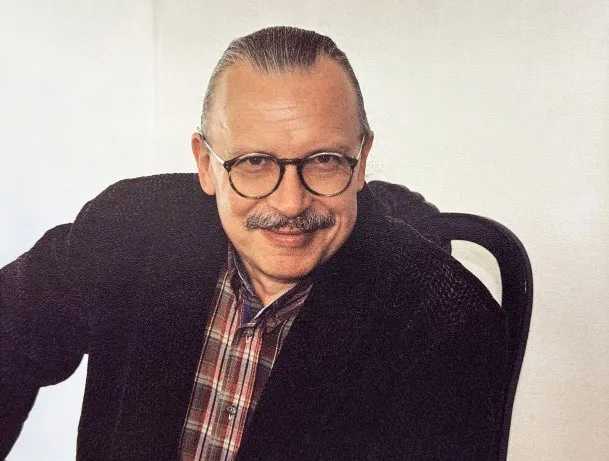
 Jacek A. Jaroszewski (born in 1950 in Ćmielów – died in 2023 in Lodz)
Architect, painter, draughtsman and graphic artist, university teacher. Graduate of the Faculty of Architecture at the Warsaw University of Technology. Diploma in 1974. From 1974-1980 he worked as an architect in Lodz. Since 1980 he was a lecturer in the Drawing and Painting Studio of the Institute of Architecture at the Lodz University of Technology. Member of the Association of Polish Architects. In 1983-1985, during his stay in Paris, he made his first lithographic sketches. He got to know this technique professionally in the studio run by Witold Warzywoda. Since 1990 he painted only watercolours, committing himself to creating 1000 works by the year 2000. At the beginning, a significant part of his oeuvre consisted of abstract and allusive paintings. Later he concentrated on capturing in watercolours the views of Paris, Venice, Lodz and Warsaw, cities which he visited during his artistic journeys, and on painting lavishly coloured depictions of flowers.
He took part in numerous solo and group exhibitions of painting and lithography at home and abroad (Poland, France, India, Japan, Canada, Germany). He participated, among others, in
Biennial of Small Painting Forms in Toruń (honorable mention), International Biennial "Small Graphic Forms Poland-Lodz", Exhibition of Artists Association "R" in Lodz, the exhibition Polish Lithography since 1900 in the National Museum in Cracow, the Exhibition of Watercolour from the Vistula River in Włocławek (award), Watercolour Triennale in Lublin (honourable mention), International Independant Exhibition of Prints in Kanagawa (Japan), Bharat Bhavan International Biennial of Prints in Bhopal (India).
Jacek A. Jaroszewski (born in 1950 in Ćmielów – died in 2023 in Lodz)
Architect, painter, draughtsman and graphic artist, university teacher. Graduate of the Faculty of Architecture at the Warsaw University of Technology. Diploma in 1974. From 1974-1980 he worked as an architect in Lodz. Since 1980 he was a lecturer in the Drawing and Painting Studio of the Institute of Architecture at the Lodz University of Technology. Member of the Association of Polish Architects. In 1983-1985, during his stay in Paris, he made his first lithographic sketches. He got to know this technique professionally in the studio run by Witold Warzywoda. Since 1990 he painted only watercolours, committing himself to creating 1000 works by the year 2000. At the beginning, a significant part of his oeuvre consisted of abstract and allusive paintings. Later he concentrated on capturing in watercolours the views of Paris, Venice, Lodz and Warsaw, cities which he visited during his artistic journeys, and on painting lavishly coloured depictions of flowers.
He took part in numerous solo and group exhibitions of painting and lithography at home and abroad (Poland, France, India, Japan, Canada, Germany). He participated, among others, in
Biennial of Small Painting Forms in Toruń (honorable mention), International Biennial "Small Graphic Forms Poland-Lodz", Exhibition of Artists Association "R" in Lodz, the exhibition Polish Lithography since 1900 in the National Museum in Cracow, the Exhibition of Watercolour from the Vistula River in Włocławek (award), Watercolour Triennale in Lublin (honourable mention), International Independant Exhibition of Prints in Kanagawa (Japan), Bharat Bhavan International Biennial of Prints in Bhopal (India).
A DIARY WRITTEN IN WATERCOLOUR
Jacek Jaroszewski painted nearly every day. Sometimes he subjected the act of creation to a particular discipline, for example when he wanted to paint a thousand watercolours in ten years for the end of the second millennium. The project documented the passage of time, emphasised the insignificance of the time dimension of human life in relation to the eternal continuum. The effort undertaken by the artist was a kind of meditation, resulting in self-discipline and humility, at the same time it opposed such attributes of everyday life as haste and lack of thoughtfulness.
One of the most important imperatives was the need to share with the viewer the emotions and reflections that made each day of his life meaningful. In the watercolours all experiences took on a more tangible, mood-saturated, realistic dimension. The subsequent paintings were like pages of the artist's personal diary, traces of his existence marked with brush and paint.
Most of the works created in the early period of Jacek Jaroszewski's career referred to the tradition of formless or allusive abstraction, as well as surrealist poetics (including the practices of Jean Fautrier, who was highly appreciated by Jaroszewski, or the artistic activities of Max Ernst, which foreshadowed the later achievements of Tachism).
The artist painted fantastic landscapes, full of organic and nonorganic structures, similar to microscopic enlargements. On the one hand, the paintings evoked various biological forms, on the other, they seemed like holes in space, as well as austere, cracked architectural structures, rocky cliffs, piled-up mountain slopes and deep precipices.
Jaroszewski was subconsciously a realist in his art, but he was interested only in selected fragments of reality, or rather only in certain levels of it. When creating his watercolour compositions, he made sure that his painting was as credible as the construction of the world around him. This correspondence was also characteristic of many of his later works: vedutas − views of the cities he visited, and depictions of flowers in which it was not just a matter of rendering a physical likeness, a detailed, almost photographic (which is very difficult in watercolours) representation of a fragment of reality, but of capturing the internal rhythms which shape the form and atmosphere of the objects.
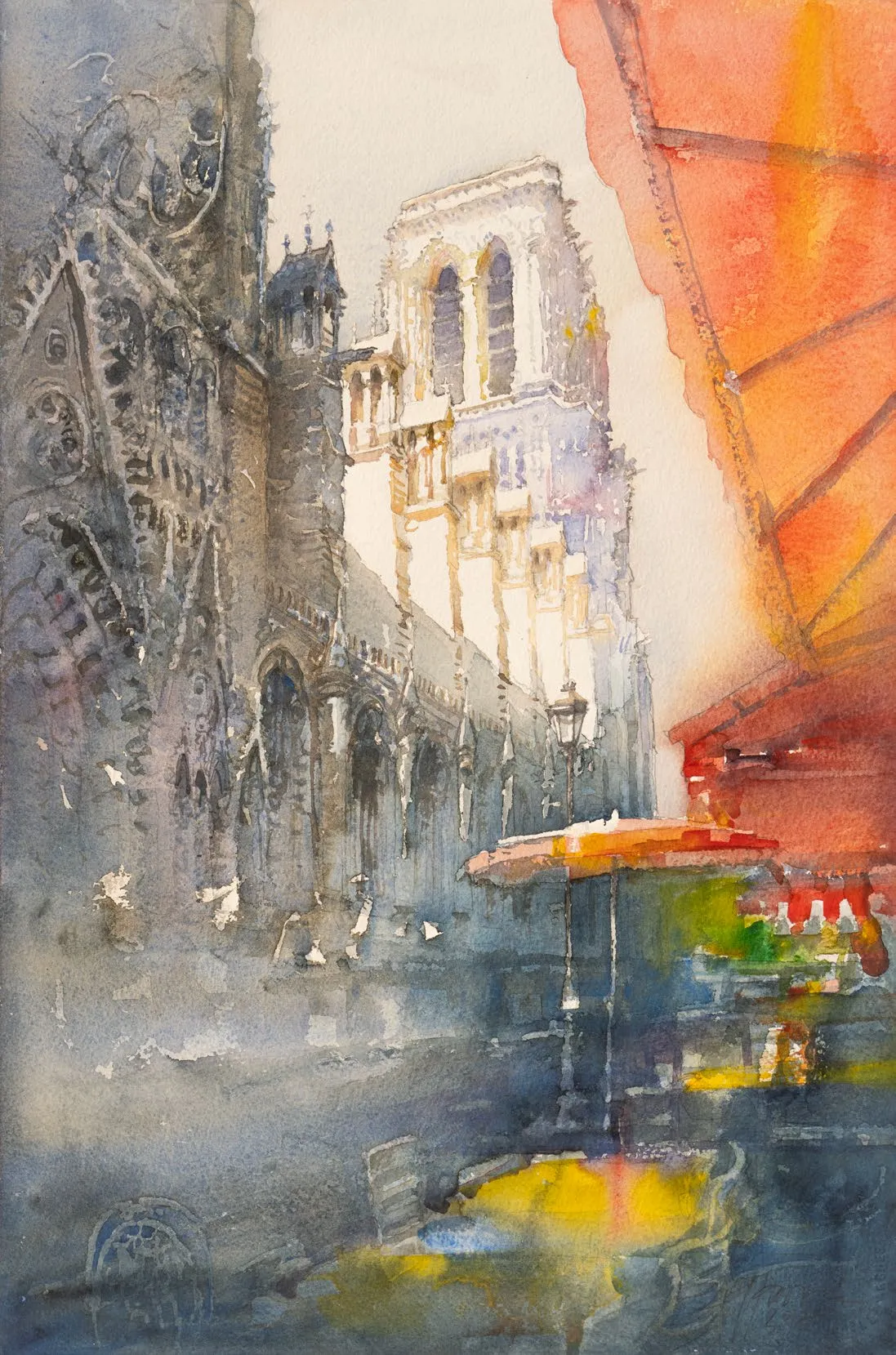
We have the impression that the places visited by Jacek Jaroszewski were not chosen at random. Paris, Athens, Venice, Pisa, Warsaw, Krakow, Kazimierz on the Vistula River provided an opportunity to go through successive epochs, styles or movements, and offered a guarantee of working through artistic themes important for European and Polish culture, including specific places and monuments, canonical and groundbreaking works. Some of the selected plans were portrayed by him repeatedly (for example, the Sacre Coeur or Notre Dame in Paris, the Doge's Palace or Santa Maria della Salute in Venice), and − as we can observe − he did it at different times of the day, in different weather conditions.
In a sense, he was alluding to the explorations of masters of past epochs who similarly studied the influence of atmosphere and light on the value and intensity of colour (Claude Lorrain, Antoine Watteau, the Impressionists).
It also seems that, as with other historical painting practitioners, he often chose a slightly different palette depending on the location; cooler tones predominated in his Parisian vedutas and warmer tones in his paintings created in southern Europe, especially in Athens, where the climate was different, with more open spaces, a different brightness and clarity, and a different angle of rays of the sun. The artist captured it in his watercolours with great sensitivity.
Jacek Jaroszewski composes his works in a colourful way, making use of significant contrasts, yet not of oppositions of light and dark colours, but of combinations of cool and warm hues. The aura of places, resulting from the climate, the current weather or the time of the day, their atmosphere often becomes a theme in its own right, at the same time co-creating the image – making it credible and inspiring to its reception. Sometimes the Artist waited for the evening in order to use a stronger contrast to give the subject the character of a nocturne. Some of the painted objects look as if they were breaking through layers of diffused light, like ships that have suddenly emerged from moist air.
This technique introduces an element of movement into the basically tranquil composition. The last of the abstract or allusive works of the 1990s were already less dynamic. They were marked by a more toned-down expression. A central composition and horizontal arrangements were much more frequent there.
Jaroszewski uses a similar approach in most of his landscapes and still lifes. Subtle dynamic accents are created in his watercolours by rhythmisation (in terms of forms and textures), by suggesting the impression of movement and by breaking with the central perspective. Sometimes the artist monumentalises selected objects in this way – he paints them from a worm's-eye view (as in one of the depictions of the Paris Opera House), or, as in the case of the complex in Pisa, from a bird's-eye view. In some Venetian vedutas, he crops the landscape in such a way that the open space of the canals deepens the perspective and "immerses" the viewer.
The artist also often shortens the perspective, focusing on fragments of the building; this is by no means surprising, after all Jaroszewski was a qualified and practising architect. He uses close-ups, as if examining selected architectural motifs and details. He succeeds in capturing the details, although the watery, capricious and flowing paint hardly succumbs to this treatment.
Some of the works are enriched with colour and, what is characteristic, it is most often blue. Thus, we touch here on another and one of the primary aspects of the work of the artist from Łódź. Blue is the colour of meditation, an attribute of universal and perfect space, a sign of transcendence.
The essential elements in Jacek Jaroszewski's works are space and luminosity. They are the starting point, the means of expression and the ultimate goal. The light does not compete with the shadow, but engages in a dialogue with it. At the same time, it directs the viewer's vision. Light is a fundamental craftsmanship problem, related to the preservation of the highest, strongest whiteness offered by an unpainted fragment of watercolour paper. The artist subdues it with superimposed layers of paint. Here, he is more interested in the quality of the hue rather than the colour itself, the richness and subtlety of tones, the detachment of the local colour from the drawing composition.
In Jaroszewski's landscape and architectural paintings, people play a minor role. Their silhouettes, most often small and simplified, only make the painting more credible, introduce a landscape context, but above all create a sense of proportion and allow the scale of the components of the composition to be rendered. Already at the beginning of his career, both in painting and in drawing and graphic art, the artist avoided the image of man. He himself was present there with his own experiences, but he stayed hidden behind the layers of pictorial motifs and means of artistic expression.
Watercolour is a difficult technique, requiring the ability to make quick decisions in applying colour. The correct composition of the image becomes particularly important in this case. Mistakes are hardly possible to remove: the few methods known to painters for retouching such imperfections do not, unfortunately, allow for their complete elimination.
Despite these limitations, a skilled watercolourist is able to choose the right way of shaping the image to achieve the desired effect. Even among the vedutas there are panoramas treated in a more sketchy manner, dominated by white, in which the artist consciously concentrates on drawing, placing patches of colour in limited parts of the plane in order to convey only the general character of the building. These works are accompanied by others, in which the artist meticulously, as far as the watercolour technique allows, reproduces details, enhances the colour layer, takes care of the consistency of the contour with the colour stain.
The artist did the same with still lifes – flower compositions, numerous in Jaroszewski's oeuvre. These paintings display all the advantages of watercolour and emphasise the variety of possibilities created by this technique. The artist was fond of portraying bouquets of flowers, even though it is a classic subject, and at the same time difficult and requiring technical mastery. Flowers, due to their complexity and variety of forms, and their particular "light-sensitivity", give the painter great scope to show off, but they also pose a challenge. It appears as if Jaroszewski was trialling his skills, putting the potential of his craft to the test. As a skilled watercolourist, he treated the floral themes in different ways − both sketchily and realistically with detail, and in such a way that the flower arrangements took on the shape of decorative tapestries. The watercolour images of blooming roses, ruffled chrysanthemums, clustered tulips, delicate nenuphars or dignified orchids are an artfully rendered expression of his admiration for the beauty of nature and the forms it contains.
Jacek Jaroszewski's works are beautiful and create specific mood. The author brilliantly employed the specific qualities of the watercolour medium, the transparency and permeation of overflowing patches of colour, the rich modulation of white and the play of luminous reflections against the subtle pinks and blues in the shadow sections. Their visual lightness is the result of many years of experience and creative practice on the road to artistic awareness and fullness, and thus also the satisfaction of the viewer, to whom the artist directed his message, saturated with emotions.
Dariusz Leśnikowski
Translated by Elżbieta Rodzeń-Leśnikowska
 KATALOG DO POBRANIA