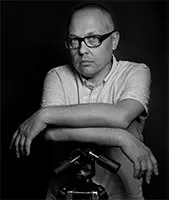
 Marek Domański
Academic teacher, photographer, curator, and artist practicing photography and related visual arts. A graduate of the Higher School of Fine Arts in Łódź, currently the Władysław Strzemiński Academy of Fine Arts in Łódź, where he runs the Photographic Imaging Studio at the Institute of Photography and Multimedia, Faculty of Fine Arts. Author and co-author of several monographs and other publications on technical, theoretical, and historical issues, contributing to a multi-threaded narrative on the post-photographic condition of contemporary photography. Curator of numerous exhibitions and organizer of research and documentary projects. He has presented his diverse photographic work in numerous solo and group exhibitions in Poland and abroad
RIVERSCAPE
REVEALING THE RIVERS
"Our civilization has poisoned the river waters and their contamination has taken on a powerful emotional sense. Since the course of a river is a symbol of time, we are inclined to think of time poisoned."
Czesław Miłosz RIVERS [1]
The awareness that Lodz 's 19 rivers are still flowing is not obvious to the city’s residents. The city would not have been built without the rivers, which provided the water and energy necessary for settlement and industrial operation. However, in a relatively short period of time they were pacified with concrete troughs, or pushed into underground channels over which houses, streets and factories were built. Today, “this thin dry ditch, this elongated depression will bring to mind a riverbed to few people.” [2] The watercourses have been cut off from their valleys, which can still be seen in the landforms, but the natural ecosystem has been exterminated. Rivers are not just water - they are a system including soil and living organisms around and below the riverbed (the hyporeic zone). According to Timothy Morton, “ecosystems are not just made up of trees, rock formations and pigs ... they are also made up of thoughts, desires and fantasies (seemingly [inside] ourselves).” [3] Lodz's rivers are sick or dead. The fact that we pushed them underground and into oblivion, forced us to make an effort, including in the space of our emotions. The dead waters of rivers and the material-discursive practices that accompany them carry great symbolic potential. Our contact with water is limited and objectifying. Astrida Neimans states: “if, in fact, as bodies we live communally, then coexistence must go beyond the human to an expanded, more extensive sense of we." [4] Rivers and people are sister entities for which flowing water is a condition of existence. If water has a memory it surely “bears the traces of its social relations, conditions and potential.” [5]. To consciously encounter water as an actor in the social network of relations, we must want it. We must try to look at our world from the non-human perspective of water, the river, the ocean. Cut off from the praocean in which life originated, we still carry it within us. In social theory, politics and science, we are seeing a “turn to fluidity.” The Heraclitean “everything flows” does not apply only to water, although the river seems an obvious metaphor for the perception of processuality - the fluidity of our world. How does the condition of our rivers resonate in this relationship? Showing solidarity with rivers must not be based on selfish fear of extinction, but on solidarity and empathy. This is not difficult if we realize that our bodies are made up of about 65% water. [6]
Breaking the destructive legacy requires abandoning the anthropocentric perspective, whose arrogance and selfishness does not allow us to see a partner in other entities in this case rivers and their ecosystems. Rivers are not our property and their objectification should be replaced by a partnership, requiring a new vision of the world that includes a hydrological perspective. A new narrative is required to initiate change. Our problem with rivers is not local. It must be viewed from the perspective of hyperobjects, [7] which, according to Morton, cannot be localized, are phasic in nature and are sticky - they stick to everything in their vicinity. The concept of hyperobject seems particularly useful here because of its ontological, epistemological and ecological implications. I have also considered Bruno Latour's actor-network theory and Graham Harman's thing-oriented ontology as crucial, in my work on the project.
The project “Riverscape. Revealing the rivers “ is part of the current of blue humanities, which draws attention to the need for a material-discursive experience of water. There is a real need/necessity to restore the subjectivity of the rivers flowing through our city. This is only possible by restoring awareness of the presence and role of rivers, and revealing their life-giving potential. It is essential to create a collective sensitivity that will enable us to include a non-human “perspective in our ecological approach to the world. We will not survive without solidarity with rivers, which we continue to treat as objects. The destruction of the river ecosystem is a kind of unconscious catastrophe. We have never been in touch with what we have lost. We have not held mourning for the loss of the rivers without which our city would not have been built. Nor do we have a sense of guilt over the colonizer's strategy of plundering water resources. We have not articulated the loss, yet if our “invisible” rivers were still flowing on the surface, every city resident could be on the banks of one of them within minutes. The renaturalization of already dead watercourses, would benefit our quality of life. Revealing the loss is possible through activities such as art and research projects, through which we will become aware of the presence of rivers and understand the need to repair the harm done to the environment and ourselves.
Timothy Morton states: “There is a lack of humanistic tools for thinking at the planetary scale, often because of our conscious reluctance to develop them." [8] I believe that our cognitive practices from a ‘bird's eye’ perspective, creating a worldview based on verticality and zonality, should morph towards a horizontal and egalitarian collage. Following Morton, we need to “tune in,” achieving a common sound with the other beings we are trying to understand. Andrew March proposes the term anthropomorphic shadow with which he describes “both the correlative way of thinking itself and the era in which casting human shadow on objects has become not only a philosophical norm, but also an often unconscious everyday practice.” [9] The question arises: how then to observe reality without casting an anthropomorphic shadow? A shadow that is a vestige of the controlling and narcissistic gaze of the rulers of the Anthropocene. [10] One solution may be Patricia Leavy's proposal to make transdisciplinary qualitative research, and art-based research in particular, a new scientific culture that transcends the boundaries of the academy. [11]
The use of large format and presentation in the form of “contacts” (4 by 5 inch contact prints) is an ironic reference to the tradition of landscape photography of the F-64 group, whose members portrayed the beauty and majesty of wildlife. The way of capturing places where rivers flow on the surface, or underneath, is reminiscent of the way of photographing Alphonse Bertillon - the “father” of forensic aesthetics, which I use in my recent projects. This approach of reducing the means of expression puts the photographer in the role of a medium that gives its resources to non-human actors. This is possible because the capacity for representation is possessed by all cultural texts, but only photography realizes the principle of making present. “Visual images are unique and can arouse a special kind of emotional and bodily emotions in people. They are usually stored in the subconscious, without undergoing the same conscious interpretive processes that apply to the reception of written text." [12] I am convinced that the experience of aesthetic experience anchored in photography can be a kind of language, mediating the observation of hyperobjects. Photography with its simultaneously documentary and evocative potential can play an important role in the change we seek.
Rivers suffer as a result of, our - human - actions, based on the desire to maximize efficiency, calculativeness but above all on an extremely limited imagination regarding the consequences of environmental transformation. This is not to say that I completely condemn the second industrial revolution, although our current situation has been shaped by the capitalist development and success of the XIX century Lodz. From this perspective, “the radical transformation of nature can be considered a necessary evil.” [13] Rivers have become victims of the capitalist system, which has absorbed and commodified our lives and colonized our imagination. Ecological politics must be in tune with our internal change, as Herbert Marcuse advocated in his recent texts. The scale of the problem is beyond the capacity of a single individual, so a sense of community must be rebuilt in concern for the entire ecosystem, which provides security for each individual. We will have to bear the consequences of the colonizing greed of our ancestors. We will answer the question ourselves: will the Anthropocene be an era of crisis and planetary rebirth, or a “great Holocene extinction”? We will not be the first civilization to fall into the “progress trap” described in the book A Brief History of Progress [14] by Ronald Wright. Instead, we are a global civilization. Our responsibility is not to a city or even a continent, but to the entire planet. Evacuation is not an option even for those who own almost all the resources. The debt owed to future generations, as Zygmunt Bauman wrote about, [15] continues to grow.
- Czesław Miłosz, Rzeki, [w:] Piesek przydrożny, Kraków 1998, s. 313.
- Maciej Robert, Rzeki, których nie ma, Wołowiec 2023, s. 68.
- Timothy Morton, Mroczna ekologia. Ku logice przyszłego współistnienia, Warszawa 2023, s. 153.
- Astrida Neimans, Ciała wodne. Pozsthumanistyczna fenomenologia feministyczna, Warszawa 2024, s. 44.
- Tamże, s. 54.
- „Rzeki stanowią około 0,0001% światowych zasobów wody, oczywiście biorąc pod uwagę wszystkie wody znajdujące się na Ziemi, również te podziemne czy zamknięte w lodowcach, a także, a raczej przede wszystkim, wody słone, czyli oceany. Rzeki są środowiskiem życia dla wielu organizmów, przez co silnie wzbogacają bioróżnorodność. Są źródłem wody pitnej, a ich obecność wpływa na regulację poziomu wód gruntowych, obieg wody i pierwiastków w przyrodzie, oraz na mikroklimat, czyli lokalną temperaturę i wilgotność powietrza. Przez wieki ludzie swoje życie wiązali z rzekami, z których mogli czerpać wodę i do których odprowadzali nieczystości, zaierane przez prąd daleko od ich siedliska.” Aleksandra Jabłońska.
- Timothy Morton, Hyperobjects. Philosophy and Ecology after the End of the World, Minneapolis 2013.
- Timothy Morton, Mroczna ekologia. Ku logice przyszłego współistnienia, Warszawa 2023, s. 55.
- Andrzej Marzec, Antropocień. Filozofia i estetyka po końcu świata, Warszawa 2021, s. 249.
- Antropocen – pojęcie zaproponowane w 2000 roku przez Eugen F. Stoermer i Paula J. Crutze, oznaczające antropogeniczne zmiany o charakterze planetarnym, głównie dotyczące klimatu.
- Patricia Leavy, Metoda spotyka sztukę. Praktyki badawcze oparte na sztuce, Warszawa 2018.
- Tamże, s. 306.
- David Harvey, Przestrzenie globalnego kapitalizmu, Warszawa 2016, s. 107.
- Ronald Wright, Krótka historia postępu, Warszawa 2021.
- Zygmunt Bauman, Życie w czasie pożyczonym, Kraków 2013.